Built for multi-tenant operators · Live at admin.posterita.com · Invite-only
Run AI agents the way you'd run junior staff.
Agency OS is the supervision layer the Posterita AI agents pass through before they touch a customer. Nina on WhatsApp, Kira inside the knowledge base, the Kai cast across our internal tooling — every consequential action they take lands in one keyboard-first inbox, with a human on the other side. Quiet when agents are right, loud when they're not, and reviewable when a regulator asks.
It is the operator console for agencies and multi-tenant operators who run AI on behalf of merchant customers. Currently invite-only — Alexandre and Fred operate it; we expand the role list deliberately.
A keyboard-first inbox for every agent decision.
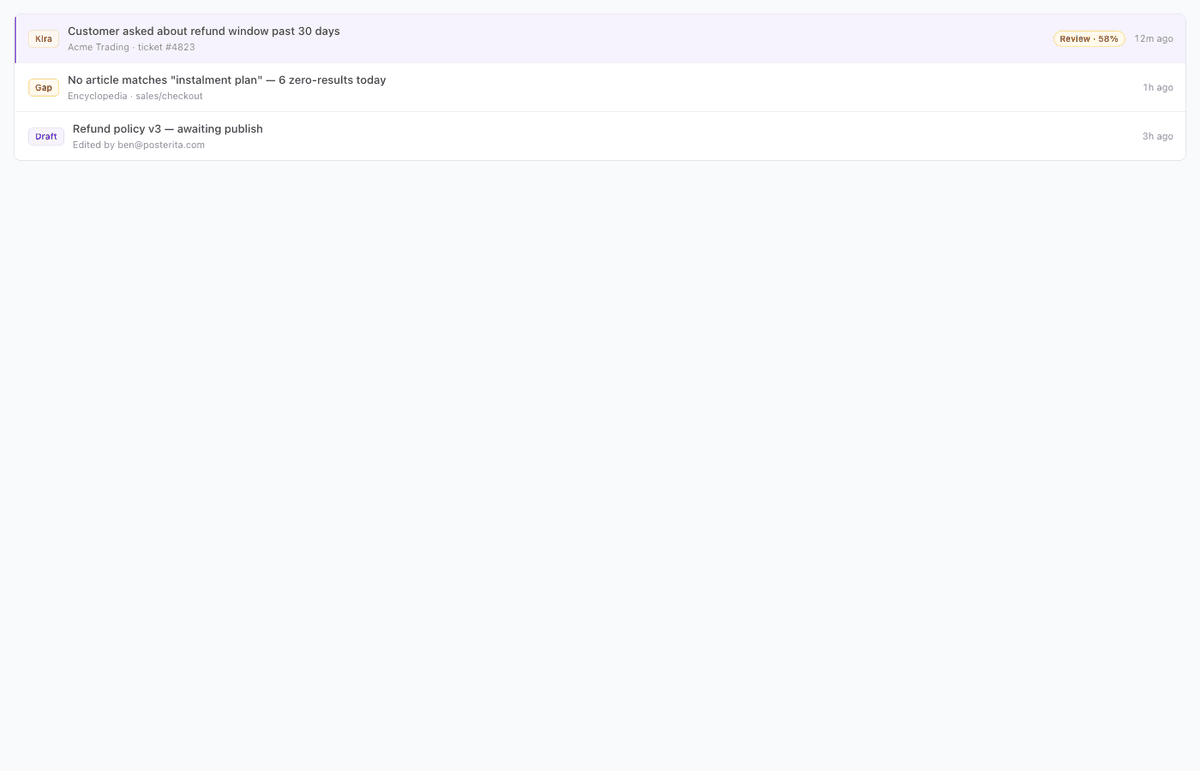
Every action an agent wants to take that needs a human flows into a single triage queue. Rows carry the agent's draft, its confidence tier, the customer context, and the tool calls it made to get there. Confident, review, unclear — the colour and the copy both change, so a tired reviewer at 9 PM can't miss the difference between a routine reply and one that needs a second look.
Approve, edit, reject. J and K to move through the queue. E to open the editor. Cmd-Enter to send. The reviewer's hands never leave the keyboard, because triage at scale is a flow state and mice break it.
This isn't a Slack channel pretending to be a workflow. Slack notifies; Agency OS records the decision, attributes it to the approver, and writes it to the audit log. There is exactly one place a reviewer looks for what needs attention, and exactly one place the audit trail picks the answer back up.
The full story of every agent run.
Click any row and the run view opens. Objective at the top — what the agent was asked to do, in plain English. Then the capability calls in order: the function the agent reached for, the arguments it passed, the tool result that came back, and the confidence the agent attached to each step. Citations and retrieved knowledge sit next to the answer that used them. Exception paths — the moment the agent escalated, retried, or backed off — are highlighted, not buried.
Runs are replayable. A reviewer can step through the trace, annotate a step that went sideways, and feed that annotation back into the eval suite. Forensic value matters most when something went wrong — and the moment a customer complains, you do not want to be reconstructing the conversation from log lines.
Pause an agent without a redeploy.
The override panel pauses a capability per tenant, or pauses an agent globally. State lives in a database row that the dispatch layer reads on every call — flip it, and the next invocation returns a freeze response instead of running. No redeploy, no feature-flag service, no scramble for the engineer with commit rights.
This is non-negotiable. Any AI production needs a single button that pauses it, accessible to the on-call operator, that takes effect in under a minute. From the Slack message to paused is about thirty seconds in practice.
Real screens from the running app.
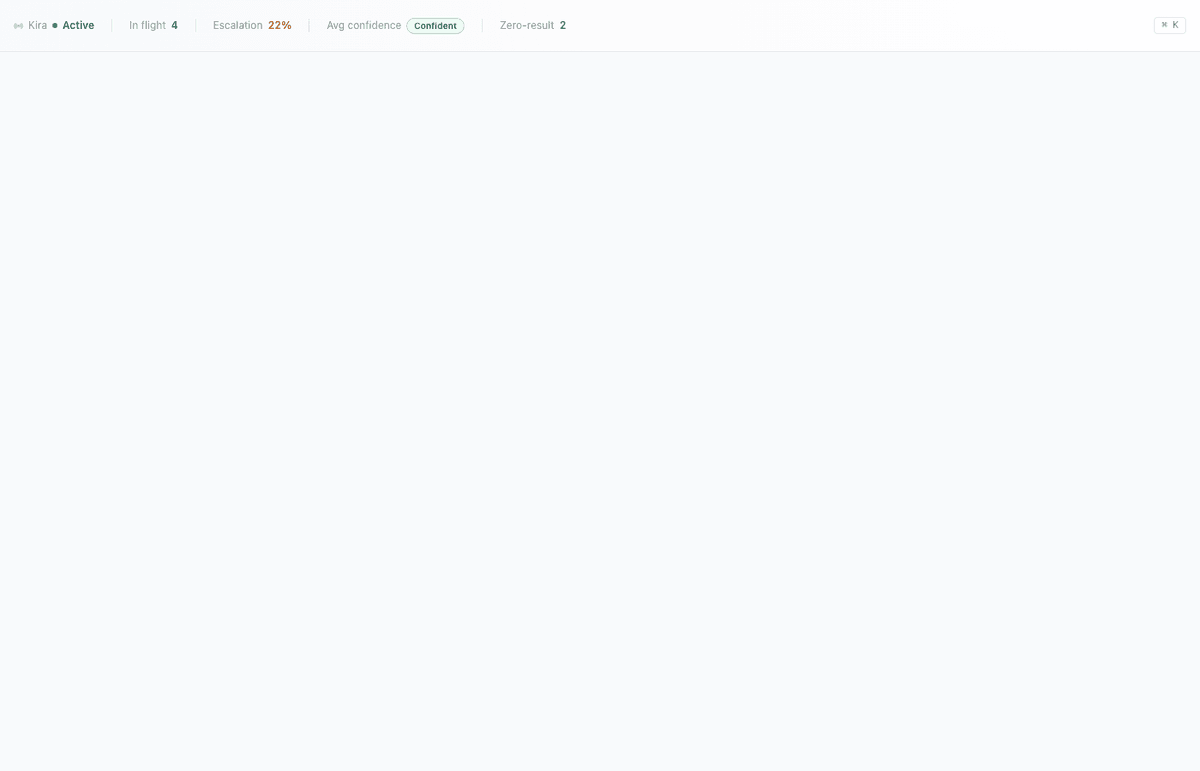
Production screenshots from admin.posterita.com — not mockups, not staged demo data with the rough edges polished off.
An audit log that survives a regulator.
Approvals, overrides, capability promotions, capability demotions, kill-switch events — every operator action against an agent writes to an append-only oversight log. No UPDATE, no DELETE. What was recorded stays recorded, because that is the only kind of audit log a regulator can believe.
The schema is built for the people who ask the questions — actor, timestamp, capability, input shape, output shape, decision, reason. Org-isolated row-level security so a Mauritius tenant never sees a row from another. Retention windows align with DPA 2017 and FIAMLA where Mauritius regulators apply; other jurisdictions are a conversation, not a checkbox.
Promote a capability only after it passes.
Every agent capability moves through an autonomy ladder — Shadow (run silently, do not act), Assisted (every action approved), Bounded (auto-execute the safe set, escalate the rest), Full-auto (act, log, sample for review). Promotions are gated by a numeric pass-rate against a frozen eval suite, and no operator can force-promote a capability without a second approver signing off.
We don't ship vibes-based AI to production. If a capability can't beat its bar on a hundred-case sample, it stays on the previous rung until it can. Demotion is the same gate run in reverse — a regression that crosses the threshold sends a capability back, automatically.
Know where the money is going before the invoice arrives.
A persistent ribbon shows per-tenant, per-agent token spend — what ran today, what ran this week, and what is trending. Anomaly detection watches for a sudden spike against the trailing baseline and alerts the operator on call. The framing is the only one that works for AI infra: surface costs, not surprises. Nobody enjoys opening a model-provider invoice and learning what last Tuesday actually cost.
Why this isn't a feature of Retail OS.
Retail OS runs the till. Agency OS supervises the AI agents that work inside Retail OS, and increasingly alongside it. The audiences are different — a cashier closes a sale; an operator decides whether an agent should have replied that way at all — and putting both into the same surface makes both worse.
Same Supabase backbone, shared customer object, separate operator surface. The boundary is intentional. You would reach for Agency OS even without Retail OS — the substrate is generic enough that another AI-agent platform can plug in, define its capabilities, and start routing through approvals and audit. The two products share a team and a compliance posture; they do not share a UI.
Questions people actually ask.
When can I get access?
Agency OS is invite-only today. We operate it ourselves for the Posterita AI agents (Nina, Kira, the Kai cast) and expand the operator role list deliberately. If you run customer-facing AI and the supervision UI is hurting, send us a note via the Talk to us link and we will line up a conversation.
Does it work with non-Posterita agents?
The substrate is generic — approvals, run drill-down, audit log, eval cockpit, kill switch — but the wiring out of the box is for the Posterita agent cast. Plugging in a third-party agent means defining its capabilities in the registry and routing its actions through the approval queue. Possible, not point-and-click. We will do it with you, not for you.
How does the kill switch propagate?
Kill-switch state lives in a single table read on every capability dispatch. Hit pause on a capability or an agent and the next call — within the same request cycle — returns the freeze response instead of executing. No redeploy. Per-tenant and global scopes are both supported. From Slack message to paused is roughly thirty seconds, including the operator opening the panel.
What about regulators outside Mauritius?
The audit log is append-only with org-isolated row-level security and the schema captures actor, capability, input, output, tier, and timestamps. That shape is what most regulators care about. We tune Mauritius DPA 2017 and FIAMLA retention because that is our home market. Other jurisdictions need a conversation about specific retention windows and disclosure requirements — talk to us before assuming a tick-box.
Can my team self-serve approvals?
Yes, once we onboard you. The approval queue has its own role model — reviewer, approver, owner — that sits alongside the broader workspace RBAC. A reviewer can approve, edit, or reject; an owner can override and access the kill switch; an auditor can read everything but mutate nothing. The role list is opinionated on purpose. Slack-channel approvals do not have roles, and that is part of the problem.
How is this different from LangSmith, Patronus, or Helicone?
Those are observability and evaluation tools — useful, and we use Langfuse for traces ourselves. Agency OS is an operator surface, not a dashboard. The difference is that an approval here is a human decision a customer is waiting on, not a metric a developer is reviewing post-hoc. The two layers complement each other. Traces tell you what happened; Agency OS is where you decide what happens next.
Is there a published price?
Not yet. Pricing for Agency OS is part of the conversation when we open up the operator role list. The substrate has real costs — Supabase backbone, model spend, on-call coverage — and we price it against the scale of the operation we are supervising for you.
AI that needs adult supervision.
If you're running customer-facing AI and the supervision UI is a Slack channel, we should talk. Agency OS is invite-only because we operate it ourselves, every day, before we open the role list.
App lives at admin.posterita.com.
The Posterita family
Retail OS runs the till. Agency OS supervises the agents. Legal OS files the company. Mail OS reads the inbox. Account OS holds the identity. DeliveryOS executes the last mile. One team, one compliance posture, an operating system for SMEs in the developing world.
Posterita Ltd is registered in the Republic of Mauritius. Read our privacy policy and terms.