Built in Mauritius · Live at app.legals.mu
Statutory work out of spreadsheets, into one platform.
Legal OS is the company-secretary platform Mauritian SMEs and management companies use to run their statutory work — register, file, sign, retain, audit. CBRD forms generated from the company register. Signatures captured under ETA 2000. KYC and retention tuned to FIAMLA. Built for the way the CBRD actually accepts a filing, not the way a generic SaaS imagines it.
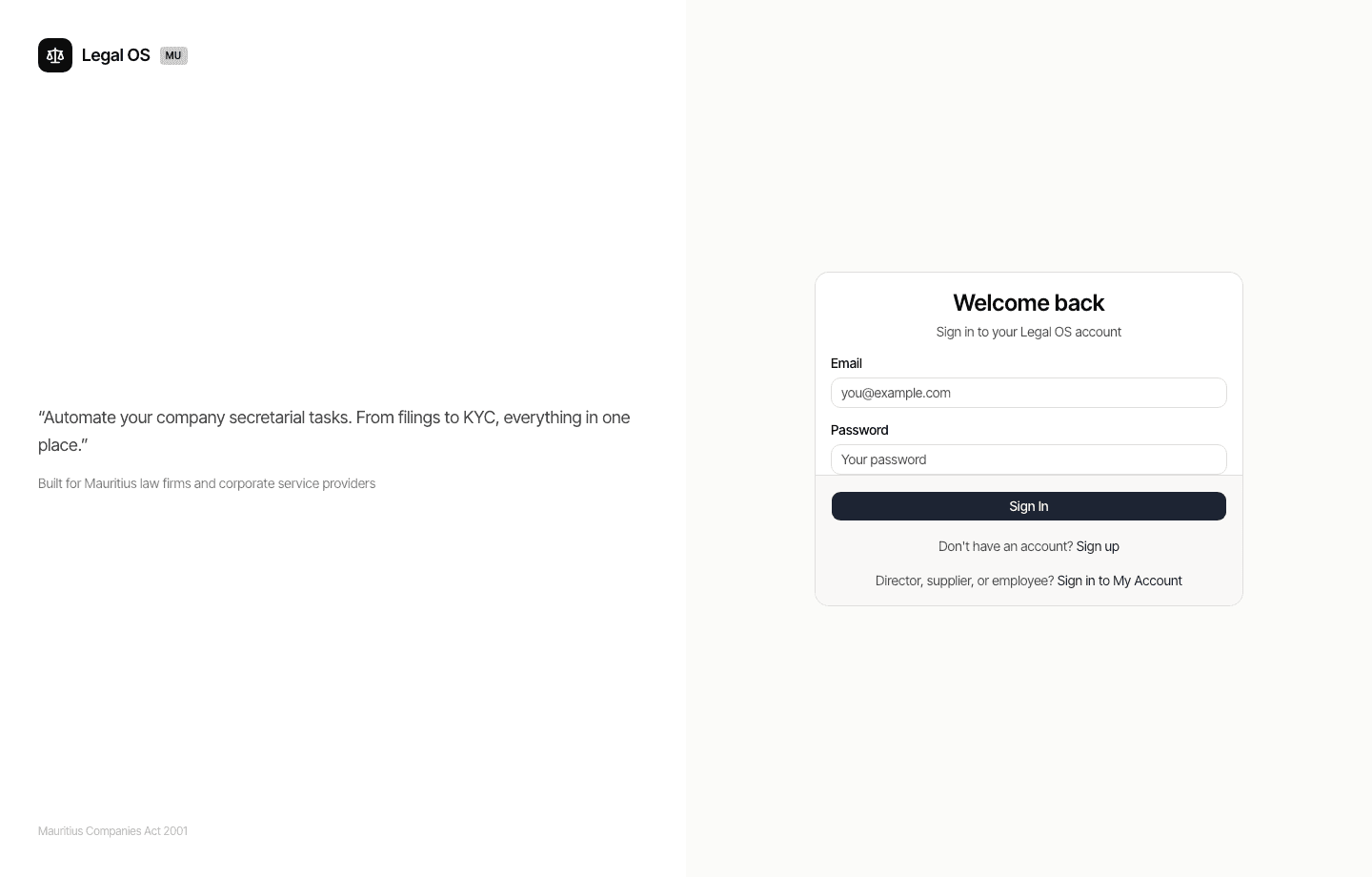
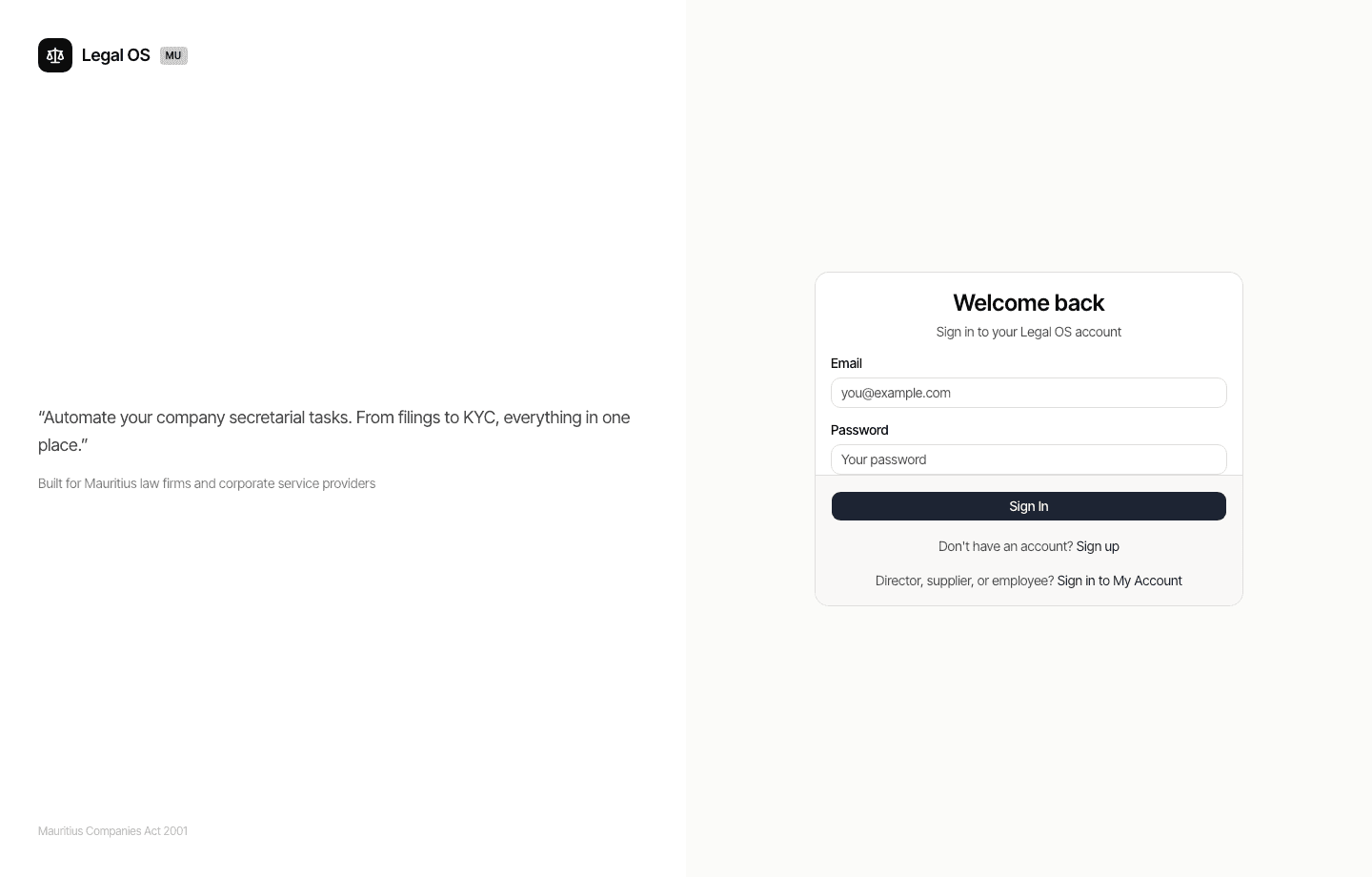
App lives at app.legals.mu. Three companies, fifty documents and three filings a month on the Free plan — no card required.
The whole workflow
Every surface a secretary uses — built for the way Mauritius works.
One workspace covers companies, persons, KYC, filings, documents, e-signatures, the regulated mailbox, compliance evidence and billing. Not a generic CRM with a forms plug-in — a tool shaped around how the CBRD, the FSC and the Data Protection Office actually expect a Mauritian company secretary to work.
- Companies & persons. 4-tier RBAC (owner / admin / manager / clerk). NIC, passport, date of birth and residential address encrypted at the database column level. Clerks see masked PII; admins see plain.
- CBRD & CBRIS filings. 16 action types — appointments, share issues, name changes, annual returns, strike-off — mapped to CBRD F-forms with daily CBRIS drift detection.
- KYC & document vault. AES-256-GCM file encryption, soft-delete only, retention windows per regulator. FIAMLA-grade for the regulated track.
- E-signatures & signing ceremony. SHA-256 document hash, intent statement, consent record — all captured in one transaction. ETA 2000 binding.
- Regulated mailbox. Gmail, Outlook and WhatsApp inbox capture, classified automatically, linked to the right company in your register.
- Append-only audit. Consent records, signatures, audit log and billing events have no UPDATE and no DELETE policies. What happened, stays recorded.
The full lifecycle
Everything from incorporation to struck-off.
A company has a life — incorporate, appoint, issue, change office, change name, file annually, restructure, wind down. Legal OS tracks all of it from one workspace, with the same evidence trail running from F7/F8/F9 on day one to F23 strike-off on day last.
On incorporation, F7, F8 and F9 are generated together with the constitution. Through the operating years, F16, F17, F18, F19, F20, F21 and F13 cover the everyday moves — directors, secretaries, registered office, share issues. F24 and F26 cover annual returns. F2 and F11 cover name changes. When a strike-off is approved by the CBRD, the company is auto-soft-deleted, every current role flips to ceased, and the audit log records why.
Every action passes through the same five-stage state machine — draft, documents generated, pending signature, filed, verified by CBRIS — so the secretary always knows what is still owed and the regulator gets the same answer the operator does.
Signing ceremony
Walk into a board meeting with your phone. Walk out with signed minutes.
Open the minutes PWA on the secretary's phone, record the meeting, let the on-device transcription produce the draft. The board reviews it on the same screen. Each director taps to sign — the SHA-256 hash of the document is stamped, the intent statement is captured (“I confirm I have reviewed these minutes and indicate my approval by applying my electronic signature, ETA 2000 s.6”), and the consent record is written in the same transaction.
The signatures table has no UPDATE policy and no DELETE policy. Once signed, immutable. The minutes leave the room already binding.

Onboarding
Three steps. No implementation project.
- 1Sign up at app.legals.mu — five minutes. Email plus password, your organisation name, the Mauritius data-protection consent. You land in the dashboard with the Free plan active.
- 2Add your first company — ten minutes. Type the BRN; CBRIS auto-fills name, directors and shareholders and promotes the record to
cbris_verified. Upload the certificate of incorporation, the constitution and the most recent annual return. - 3Invite your team — two minutes. Pick a role per teammate — owner, admin, manager or clerk — and send the invite. Clerks get the day-to-day register; managers and admins can sign and file.
No consultant-priced rollout. No six-month configuration project. File your first F-form the same afternoon.
Pricing
Pay per filing. No per-user tax.
The platform is free to use. Filings cost MUR 100 to MUR 500 each, depending on tier — a simple annual return is one credit, a name change is three and a half, an incorporation is five. Pay with a credit pack and the per-filing rate drops. Every active organisation gets three free filings a month, so a small SME secretary can run a single company without ever paying us.
Billing is per organisation, not per seat. Invite the whole team without watching the meter tick.
Built for the regulator
Compliance is not a checklist. It's the architecture.
Data Protection Act 2017 carries a MUR 200,000 penalty and up to five years. FIAMLA imposes five-to-seven-year retention on KYC and filings. The Electronic Transactions Act 2000 sets the bar for an enforceable e-signature. None of those are bolted on as features — they sit underneath every table in the schema.
- Field-level PII encryption. NIC, passport, DOB, residential address — encrypted by pgcrypto, decrypted only for authorised roles.
- Row-level security on every table. Organisation-isolated. A clerk in one workspace cannot see another workspace's rows, even by mistake.
- Append-only tables. Consent records, signatures, audit log and billing events have no UPDATE and no DELETE policies. Period.
- FIAMLA retention overrides. KYC documents soft-delete only. The hard-delete option does not exist in code — the regulator does not allow it.
Who it's for
For SMEs and for management companies.
SMEs & in-house secretaries
Self-signup, immediate access. Three companies and three filings a month on the Free plan — enough to run a single SME's register and file its annual return without ever paying. Upgrade to Pro when your filing volume warrants it.
Management companies & CSPs
Hand-onboarded. We line up the RBAC scope, the KYC retention windows and the FIAMLA evidence to match your FSC licence conditions before you bring the first engagement onto the platform.
FAQ
Questions people actually ask.
- Is Legal OS approved by the CBRD?
- Legal OS prepares filing packages — sealed CBRD F-series PDFs with the required board resolutions, signatures, and supporting documents. The user submits the package through their own CBRD account; Legal OS tracks status and reconciles drift against CBRIS daily. It is a preparation and evidence-keeping tool, not a CBRD-replacement front end.
- What about data sovereignty and the Data Protection Act?
- Data lives on a Supabase EU-West Postgres project. Sensitive person fields — NIC, passport, date of birth, residential address — are encrypted at the database column level. Uploaded files are encrypted with AES-256-GCM at rest. Consent records, signatures, the audit log, and billing events are append-only — no UPDATE, no DELETE, ever. Cross-border transfer adequacy and processor DPAs are tracked in our Production Readiness Checklist.
- Can I use Legal OS for one company, or do I need several?
- One company is fine. The Free plan covers three companies and gives you three free filings each calendar month — enough for a small SME secretary to run their own register and file an annual return without paying. Paid actions are charged per filing on a credit balance, not per seat, so a one-company shop stays cheap.
- How does FIAMLA AML/CFT retention work?
- KYC documents are soft-deleted only — `is_deleted + deleted_at` flags — never hard-deleted, regardless of what the operator clicks. Filing records and generated documents are retained for seven years. The audit trail is immutable. This overrides DPA 2017 deletion rights where FIAMLA retention applies, exactly as the regulator expects.
- Is the e-signature legally binding?
- Yes, under the Electronic Transactions Act 2000. Every signature captures a SHA-256 hash of the document, a written intent statement (ETA 2000 s.6 language), and a consent record — all in one database transaction. The signatures table has no UPDATE and no DELETE policies, so what was signed stays signed.
- Do I keep my CBRD account?
- Yes. Legal OS does not replace your CBRD account — it prepares the filing, captures the signatures, and gives you the package to submit. We sync status from CBRIS daily and flag drift so a filing you thought went through but didn't is visible inside the app the next morning.
- Is there a CSP / management-company track?
- Yes. Corporate service providers and management companies running multiple regulated engagements get hand-onboarded so the FSC-grade controls — RBAC scope, KYC retention windows, FIAMLA evidence, billing tier — match your licence conditions. Self-signup at app.legals.mu is the right path for an in-house secretary; the CSP track is a conversation.
Stop assembling your workflow.
Three companies, three filings, fifty documents a month — free until your work outgrows it. Sign up and run your first filing this afternoon.
The Posterita family
Retail OS runs the till. Agency OS supervises the agents. Mail OS reads the inbox. Account OS holds the identity. DeliveryOS executes the last mile. Commerce OS turns WhatsApp into a storefront. One team, one compliance posture, an operating system for SMEs in the developing world.
Posterita Ltd is registered in the Republic of Mauritius. Read our privacy policy and terms.